



Recognising Pressure Ulcers in Darker Skin Tones
 ;
;
While pressure ulcers in patients with dark skin tones is an under researched, there is evidence to show that people with dark skin tones are at a greater risk of developing higher category pressure ulcers.¹
Early identification of pressure ulcers is critical for preventing avoidable harm—but for patients with darker skin tones, the first signs of pressure damage can be significantly harder to detect and the cause could've occured in the 48 hours prior to visible skin damage presenting.² Variations in pigmentation can mask the classic erythema or redness that clinicians are trained to look for, which means subtle indicators of tissue damage can easily be missed.
This guide supports UK healthcare professionals in improving the accuracy and consistency of pressure ulcer assessment using evidence-based techniques and recognised best-practice recommendations.
Indicators of pressure damage in dark skin tones
In dark skin tones:¹
- Changes in colour, such as redness or other discolouration
- Change in temperature, initially warmth which can become cooler as tissue death occurs
- Change in tissue consistency or skin may feel tight or shiny
Use objective systems to describe skin colour
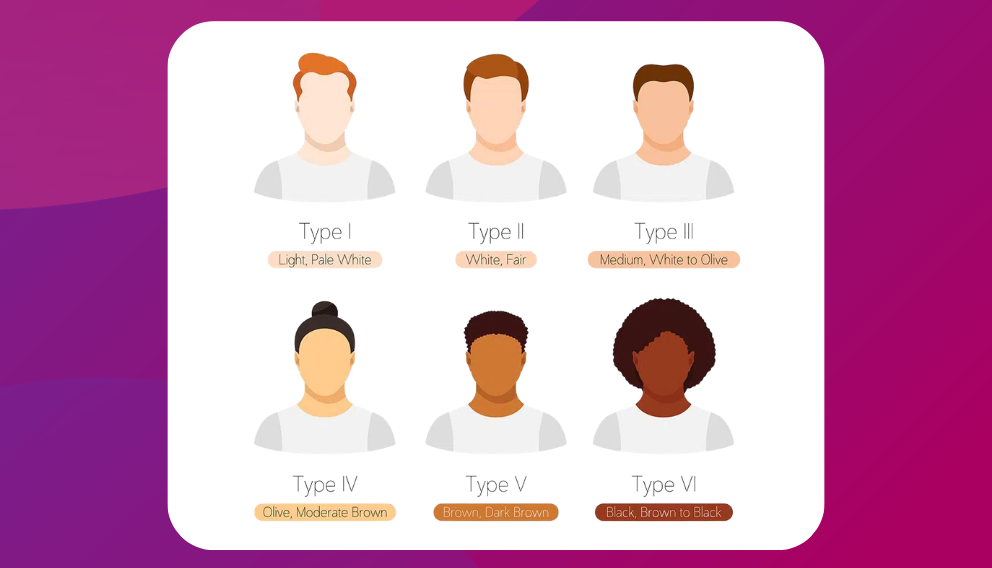
When assessing patients for pressure ulcers, avoid subjective or ethnicity-based descriptors. Instead, use an objective tool such as the Fitzpatrick skin type² scale to describe skin tone accurately. Colour charts support consistent decision-making, improve communication across multidisciplinary teams and help ensure early signs of pressure injury are not overlooked.
Another option to use when assessing is the skin tone tool. This is a validated classification tool that shows a range of skin tones (below) so that the tone can be selected that most closely matches the patient’s inside upper arm. The skin tone tool has been found to be a simple and can be used across care settings, including in patients who may have limited literacy.³
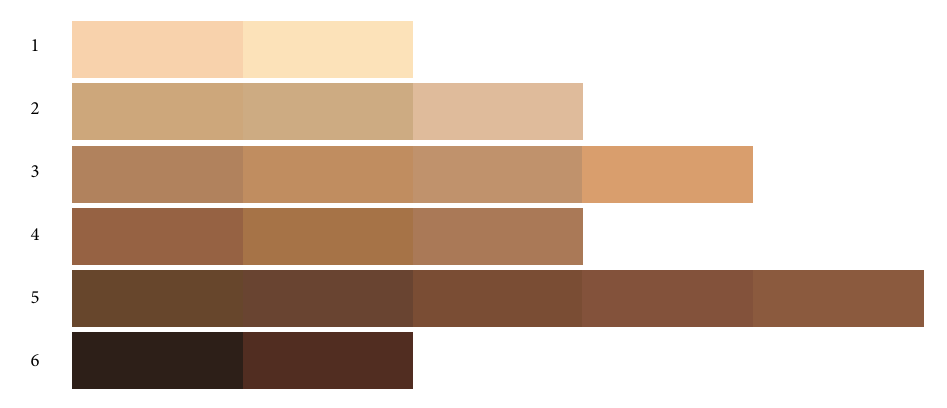
Skin tone tool (adapted from Ho and Robinson, 2015)
Maintain a high index of suspicion for pressure damage in darker skin²
As mentioned, patients with darker skin tones may not show visible pressure-related discolouration until up to 48 hours after the tissue damage has occurred. This reinforces the importance of taking a thorough clinical history, including immobility, device-related pressure and recent illness. Even when skin appears normal, subtle changes in texture or patient-reported discomfort may indicate early tissue injury.
Use good lighting to improve skin assessment²
Lighting significantly affects the detection of early pressure ulcer changes. Natural daylight is ideal, but if unavailable, use a pen torch or mobile phone light. Avoid fluorescent lighting, which can cast a blue-grey tone on darker skin and mask subtle discolouration. Optimal lighting enhances the visibility of early warning signs such as warmth, coolness or induration.
With darkly pigmented skin, the early signs of skin color change are blunted by the pigment in the skin. Therefore, be alert and have a high index of suspicion for pressure injury in patients with dark skin tones.
Baseline skin tone should be established in an area not frequently exposed to ultraviolet radiation¹ such as the inside of the arm.
Thoroughly cleanse area to be assessed by removing bodily fluids and skin care products.
Compare the skin under pressure to adjacent areas²
Comparing the site under pressure with nearby unaffected skin can reveal early pressure damage that may not be immediately visible. Look for differences such as darker or lighter pigmentation, purple or ashy tones, dryness or altered texture. Relative comparison is especially useful when assessing Stage 1 pressure ulcers in darker skin.
Moisten the skin to enhance your visual assessment²
Because darker skin may be naturally thicker or drier, lightly moistening the area can help rehydrate the epidermis and highlight underlying colour changes. This quick technique can make pigmentation differences more noticeable and support more confident pressure ulcer assessment.
Palpate the skin for induration, hardness or temperature change²
Dark skin rarely shows a blanching response, and erythema may be hard to detect. It's important to assess for other indicators such as a purple/bluish discoloration if possible.
Pressure damage is not only visual, palpation is essential. Assess for firmness, coolness, warmth or localised oedema. These tactile changes often present before visible discolouration and may be the earliest indicator of developing tissue damage in patients with darker skin.
As with all of the above points, listening to the patients and asking questions about their past history and current situation can help to understand pain and changes in any skin sensation. Listen to the patients perspective, both to aid accurate assessment and to understand their choices, needs and preferences.¹
Challenges and considerations for dark skin tone assessment
A more comprehensive skin assessment for dark skin tones should be completed that incorporates a range of the above points, as well as utilisation of something like the Skin Tone Scale. Be aware of special considerations and educational gaps for dark skin tone assessment to improve outcomes and refer to the European Pressure Ulcer Advisory Panel (EPUAP) for ongoing guidance on dark skin tone assessment as the standards of care continue to develop.
1. Black, J., Dhoonmoon, L., & Oozgeer Gunowa, N. (2023). Pressure Ulcers and Skin Tone Made Easy. Wounds International, September 2023.
2. Black, J. and Simende, A., "Ten top tips: assessing darkly pigmented skin," Wounds International, vol. 11, no. 3, 27 September 2020, pp. 8-11, <https://brnw.ch/21wXyxV>, accessed 16 September 2025.
3. Wounds UK (2021) Best Practice Statement: Addressing skin tone bias in wound care: assessing signs and symptoms in people with dark skin tones. Wounds UK, London. https://wounds-uk.com/wp-content/uploads/2023/02/191ac9b79f47de2896cf1a30f39037f5.pdf
Blogs
05/09/2024

Wound healing in hard-to-heal cases
Despite advances in dressing technology and best practice, wound care is in crisis. Successful treatment requires an ...
Read more Read more28/08/2024
How to recognise wound biofilm
Spotting biofilm with the naked eye can be a challenge due to its microscopic structure. Knowing how to recognise wou...
Read more Read more27/08/2024
Why is biofilm so resistant?
Read our latest blog to learn what makes biofilm a tricky customer and how the right wound dressing can destroy it.
Read more Read more09/09/2024
How does biofilm affect wound healing?
In wound healing, the intricate relationship between cellular processes orchestrates the healing journey, but there i...
Read more Read more22/08/2025
What the Latest NICE Guidance Means for Antimicrobial Wound Dressings
Read more Read more21/10/2025

Lessons from the Wound Hygiene Podcast Series
The Wound Hygiene Bitesize Podcast series explores the four-step protocol of care, designed to simplify and standardi...
Read more Read more